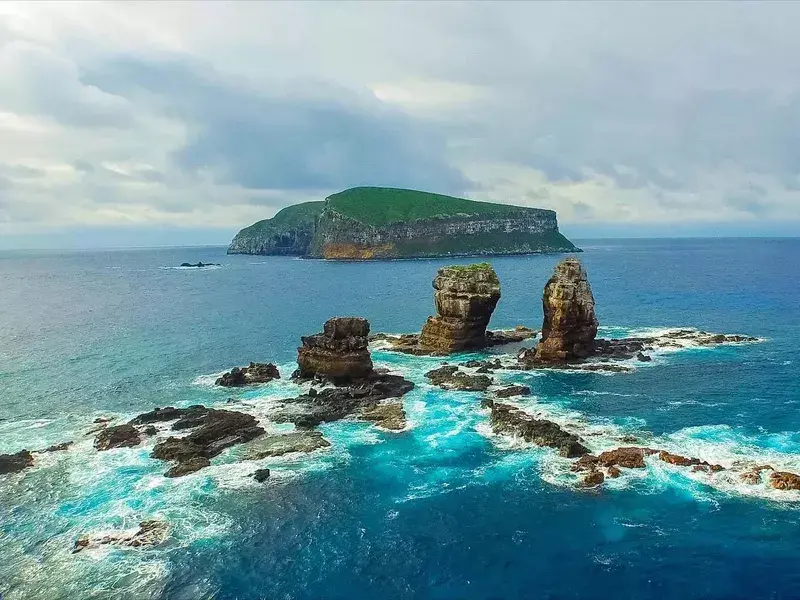
Experienced divers agree that Wolf & Darwin offer some of the world's best diving. No land visits here, just some serious diving. At Darwin`s Northern Arch, the northern most point of the two islands, schools of hammerhead sharks and groups of bottle nose dolphins often swim in clear view of divers. Divers often see whale sharks and giant manta rays.
The dives reveal sea lions, reef fish, hammerhead sharks, giant manta rays, white-tipped reef sharks, and invertebrates. Occasionally, whale sharks, humpback whales or dolphins swim in this area and if you are lucky, you may find the endemic fur sea lion.
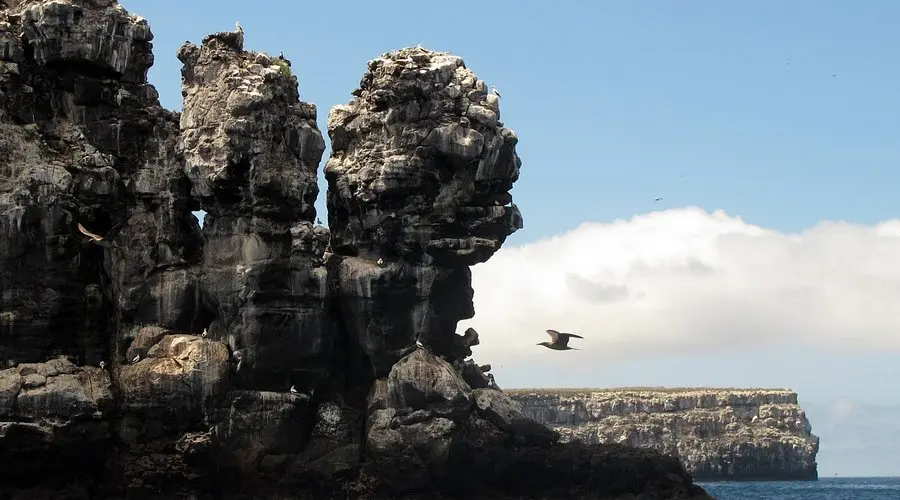
At Wolf the pinnacle, the reef and the south islet channel offer three different dive sites. The reef, which is the most consistent place to see hammerhead sharks, contains many warm water fish species found nowhere else in the islands.
Gordon Rocks, an advanced dive, is famous for white-tipped, hammerhead the Galapagos shark, large moray eels, spotted eagle rays, golden rays, sting rays, fur sea lions, sea turtles, amberjacks, reef fish, sponges and black coral. Dive with wahoo, tuna, sailfish and other big pelagic fish. Divers consider the wall at Gordon Rocks one of the best dive sites in the Central Islands. The current is strong and the maximum depth is 100 feet.
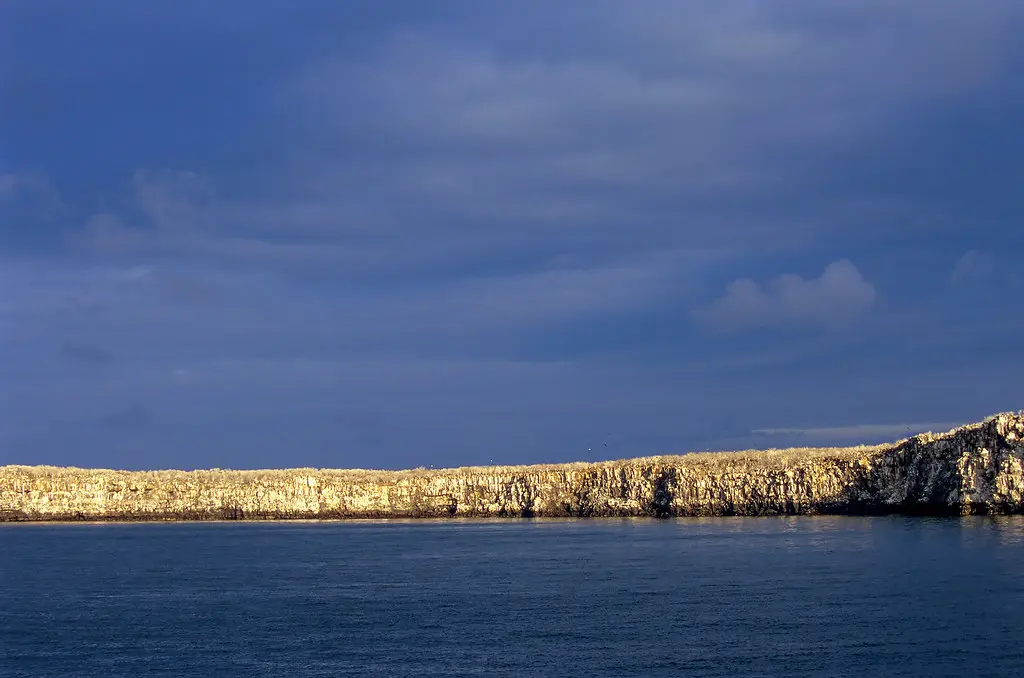
This 14 sqkm2 island is the tip of a submerged shield volcano that rises 76 meters above sea level. Its central crater is filled with salt water.
Located in the northeast section of Galapagos. Tower is an outpost for many seabirds and is a favorite among birders. Darwin Bay is actually the caldera of an extinct, partially eroded volcano. With the surrounding cliffs forming the inner portion of the rim in a forest of salt bush, we find colonies of nesting great frigate birds and red-footed boobies. A coral beach offers an opportunity for a swim. This calm bay offers a chance to explore by sea kayak.
In this bay we can find the masked booby, great frigatebird, red billed tropic bird, swallow-tailed gull, lava gull, marine iguana, storm petrel, short-eared owl, brown pelican, yellow crowned night heron, Galapagos dove, large ground finch.
Usually we visit this place by boat (panga) along the base of the cliffs. We climb up a steep rock staircase. At the top, the trail leads to an open area of nesting masked boobies and red-footed boobies that are perched on branches of Palo Santo trees. Storm petrels are found in the open lava fields at the end of the trail, which are prey for the short-eared owls.
Here you can find masked booby, great frigatebird, red-footed booby, red-billed tropic bird, swallow-tailed gull, lava gull, marine iguana, storm petrel, short-eared owl, brown pelican, yellow crowned night heron, Galapagos dove, large ground finch.
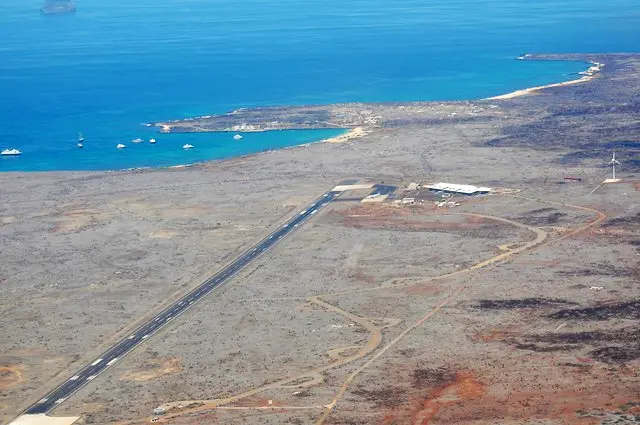
A small island north of Santa Cruz, Baltra is serviced by Tame airlines with two daily flights from the mainland. Baltra is connected to Santa Cruz Island by a ferry that crosses the Itabaca channel daily. The port is used by the Ecuadorian Navy and is also the site of an air force base.
Baltra Airport was built by the Americans during World War II, as an Army base to defend the Panama Canal. Today, it is a civil and military airport, as well as a naval base.
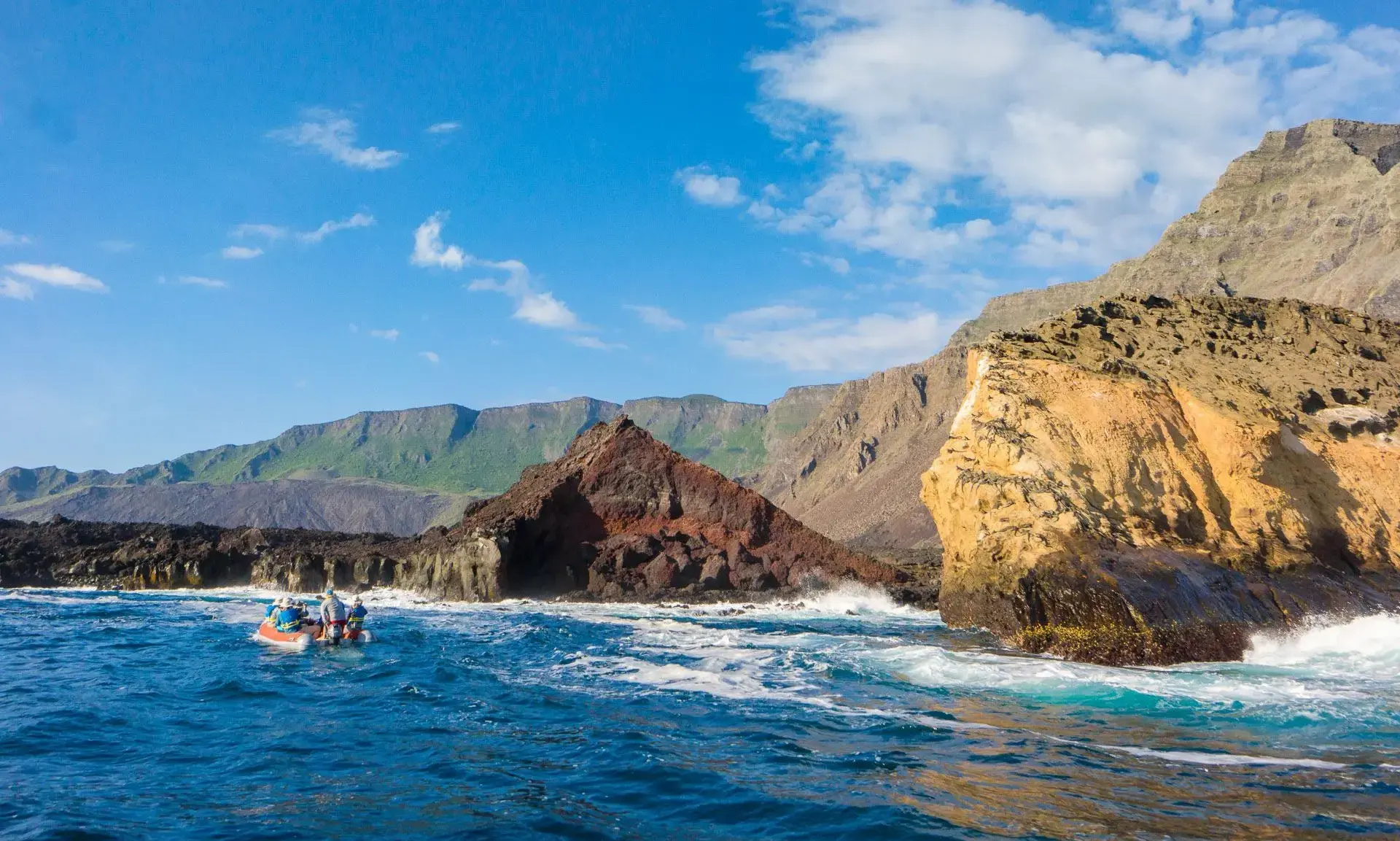
Created by the extensive lava flow of six volcanoes, of which five are still active, this 1800 square mile island is the largest in Galapagos. Tagus Cove was the favorite early pirate and whaler anchorage. Graffiti dating back to the 1800s is written on the rocky cliff. The trail leads to a salt-water lagoon and a great view of the lava fields, volcanic formation and the ocean. Explore this cove by panga (boat) or sea kayak where you will find Galapagos penguins, and other sea birds like blue-footed booby, frigatebirds, audubon shearwater, noddi tern and Galapagos hawk and marine life.

Located on the west coast of Isabela Island at the foot of the Alcedo Volcano, it was uplifted from the sea in 1954. The site is relatively flat, where the visitor has the opportunity to see coral heads and other marine formations left on the surface after the uplift. A walk will show land and marine iguanas and (occasionally) giant tortoises. Flightless cormorants and pelicans nest along the coast during their breeding season. Here it is possible to snorkel.
Here we may see lava fields, flamingo lagoons, some cormorants and penguins.
This place offers a panga ride to see penguins, cormorants, sea turtles and quiet mangrove lagoons.

This village is located on the southeastern coast of Isabela Island. Pto. Villamil has some of Galapagos’ most beautiful beaches, along with a number of brackish water lagoons, which provide refuge to migratory birds that arrive in Galapagos. The Giant Tortoise Rearing Center can also be visited. Here National Park Wardens collect adults (to mate in captivity) and eggs of giant tortoises from the two southern volcanoes on Isabela Island. Hatchlings are raised for several years, and then reintroduced to their habitat. Another site that we visit in this unique area is Las Tintoreras, where without having to get wet you can watch white-tipped reef sharks. It is possible to snorkel in Pto. Villamil.
Located at the southern end of Isabela Island, this is one of the most impressive volcanoes of the Archipelago. Its caldera measures 10 Km across from north to south. A visit to this area is quite impressive in addition to its attractiveness. Following the rim of the caldera to the north, a site called “ Volcan Chico” is reached comprising of a group of small craters and fumaroles. If you head south to the end of the rim of Sierra Negra Volcano the so-called “ Sulphur Volcano” is reached, where huge amounts of sulphur are found due to the continuous action of the fumaroles.
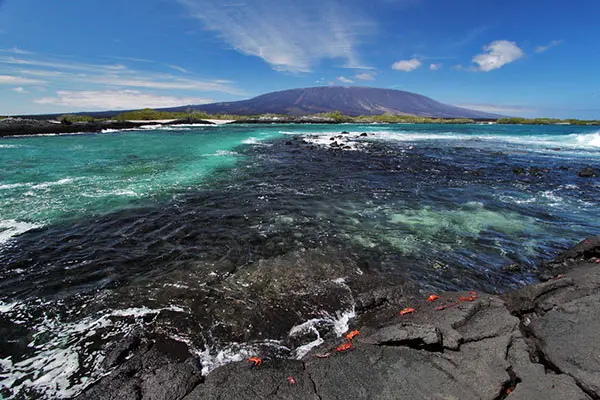
Fernandina is located at the west end of the archipelago. The colossal shield of Fernandina volcano reaches 1494 m and is still very active. The island has a surface area of 643 sqkm2 and it is the youngest and most pristine island in Galapagos, with no introduced species to date and recent lava flows formed by an active volcano are evident. Along the shoreline hundreds of marine iguanas form the largest colony found in Galapagos. Sea lions with resident bulls guard their territory. Flightless cormorants build their nests on the point. Galapagos hawks fly overhead. Snorkeling possible.
Its vegetation, typical of the arid zone, is concentrated in kipukas (small areas left untouched by recent lava). Also here you can find some representative plants such as the mangroves, brachycereus cactus and mollugo snodrassii.
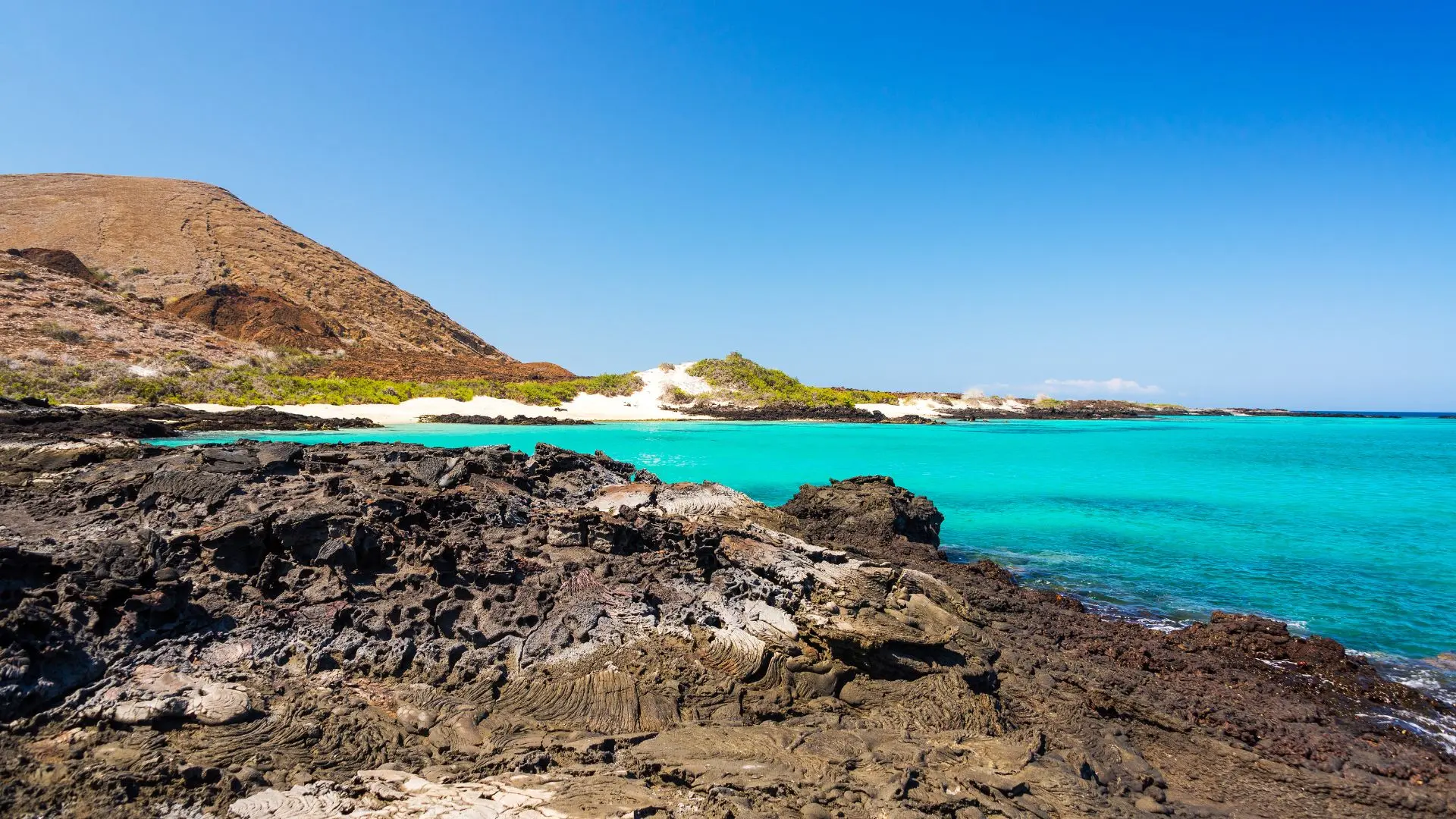
With a surface area of 585 sqkm2, Santiago is the fourth largest island. Its main volcano rises to a height of 907 m. All vegetation zones, from coastal to humid, are represented. However, the vegetation of Santiago is altered due to the presence of feral goats. It is a dramatic island covered with lava flows and arid vegetation. Many animals were introduced here such as feral goats, wild pigs, donkeys and rats. Upon landing, we find a black sand beach and the remains of a salt mine enterprise. Along the shore, we find some marine life caught in tidal pools. Marine iguanas graze on exposed green algae. This visit ends at the grottos, deep pools of clear water, where we encounter the fur sea lion, once thought to be on the verge of extinction. Snorkeling possible.
On this island you can find sea lions, Galapagos hawk, marine iguana, sally light foot crab, American oystercatcher, great blue heron, lava heron, yellow-crowed night heron. Also you can find different plant life such as palo santo trees, molluyu, brachycereus, beach morning glory, opuntia cactus, scutia, pauciflors, alternantherp, castela galageia.
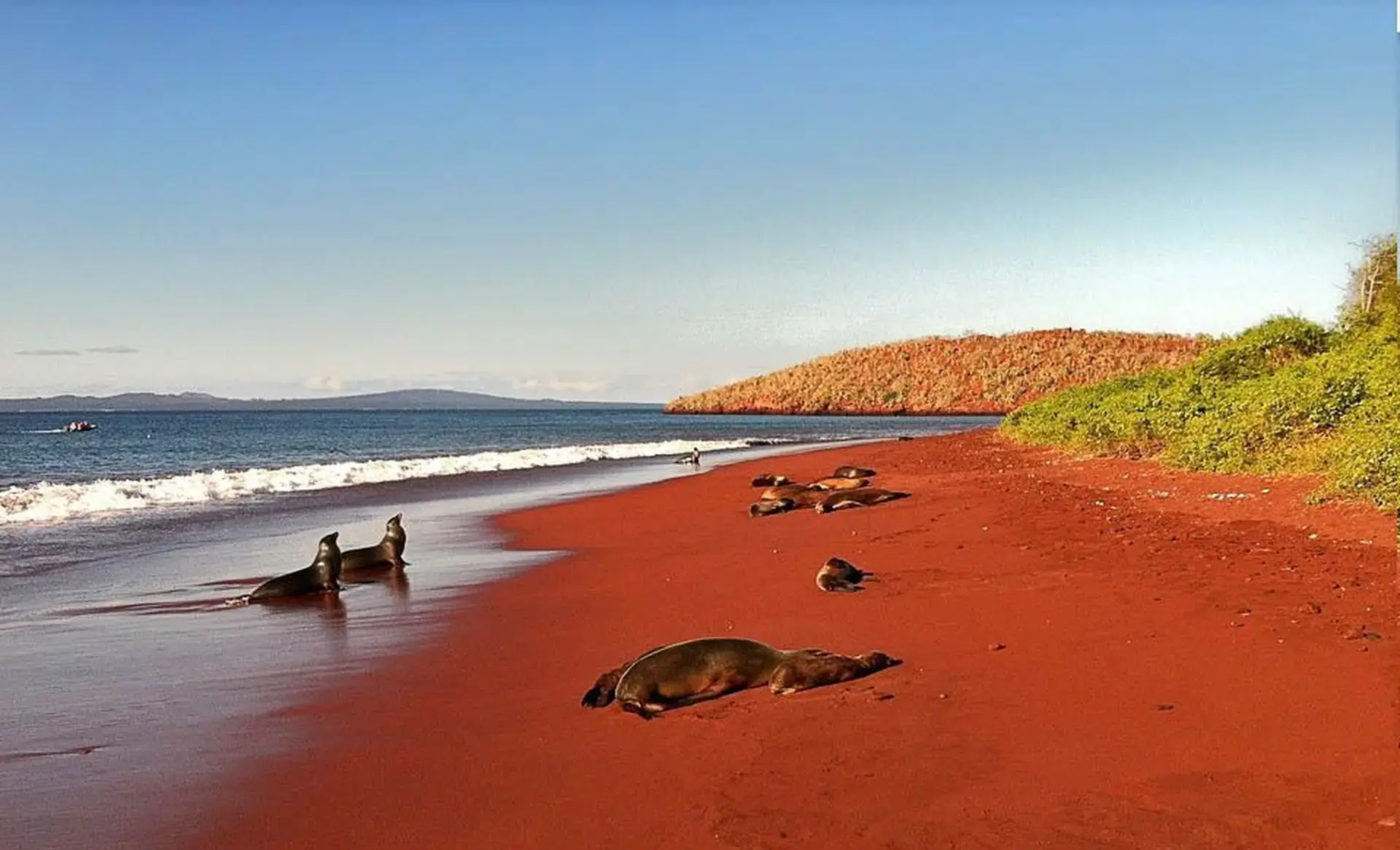
A small island (5 sqkm2) covered by dry and coastal vegetation that has a central volcano of 367 m2. Rabida contains the largest variety of lava types, red being the dominant color. Located off James Island. Rabida has the most diversified volcanic rocks of all the islands and is considered the geographic center of Galapagos. This dark red-colored beach is volcanic in origin. The trail leads to a salt-water lagoon, where we may find the great flamingo feeding. The mangrove at the far side of the lagoon is a nesting area for the brown pelican. After the walk, there is an excellent opportunity to snorkel.
Also it is possible to find white-cheeked pintail ducks, sea lions, common stilt, palo santo and opuntia cactus.
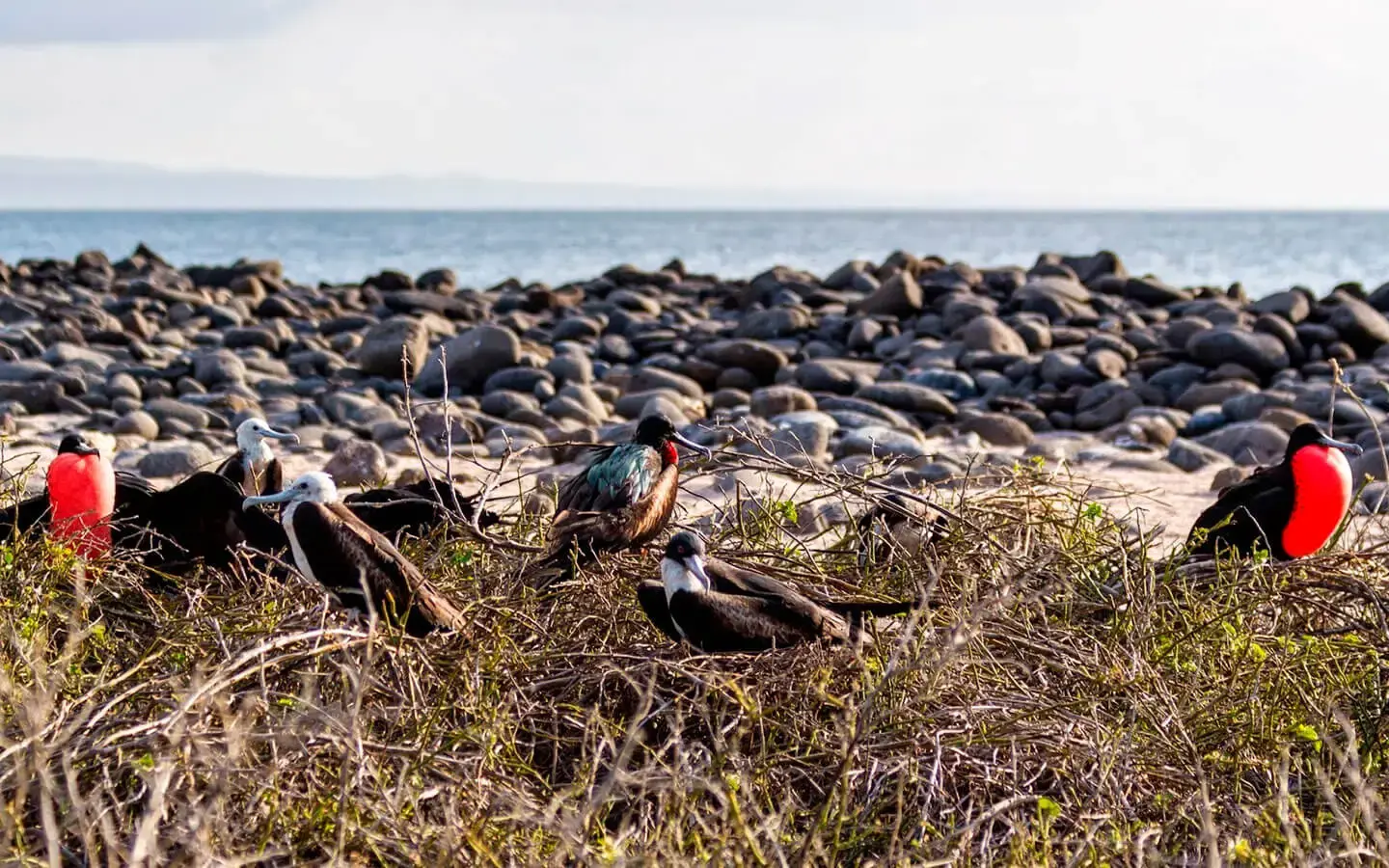
It’s a small, flat island typical of the arid zone. Palo Santo is endemic to the island. A trail makes a loop to the southwest, inland and along the rocky coast, crossing a colony of blue-footed boobies, followed by a colony of magnificent frigates. Their nests of twigs are made on the Palo Santos as well as on the salt bushes bordering the beach.
Sea lions bask on the black lava rocks and the surf crashes on the rocky shore of the coast at sunset. Snorkeling possible.
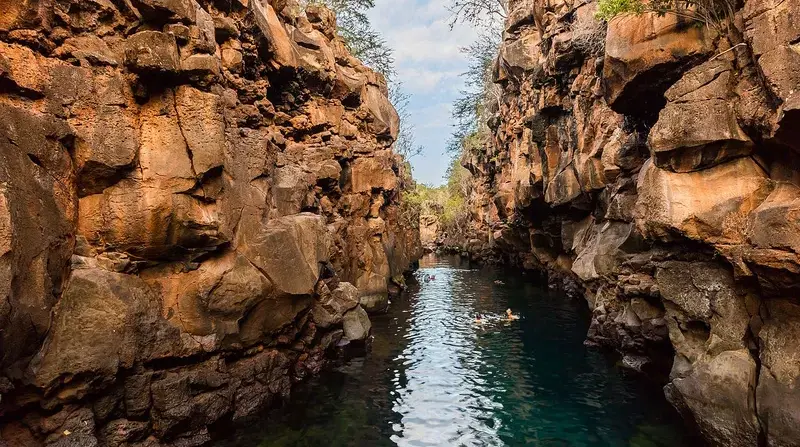
With a surface area of 986 sqkm2, Santa Cruz is the second largest island of the Archipelago. Colonized since the 1920’s, Puerto Ayora, the populated part of the island, is the most important harbor of the Archipelago. With altitudes reaching 864 m. this island comprises of all plant zones, ranging from coastal to pampas. It is the home of the Charles Darwin Research Station and Galapagos National Park headquarters. Here you will learn first hand of the conservation and research efforts on the islands. See the tortoise hatchlings and breeding programs which are saving several races of tortoises from extinction. Tour the Van Straelen Exhibit Hall. Stroll through the town of Puerto Ayora to buy souvenirs, mail postcards and absorb some local color in the social heart of the islands. Tourism, boat repair, fishing and agriculture are the major trades.
The scenery of the highlands of Santa Cruz continually changes as we ascend through all seven different vegetation zones. When present (June to January) we are able to see the giant tortoises in the wild at a private farm. Visit a pair of large pit craters called “ Los Gemelos” (Spanish word for twins) and the largest lava tunnels found in Galapagos.
On this island we can see giant tortoises, vermillion flycatcher, large billed flycatcher, Darwin finches, pampa (fernsedge zone), scalesia trees, moconia.
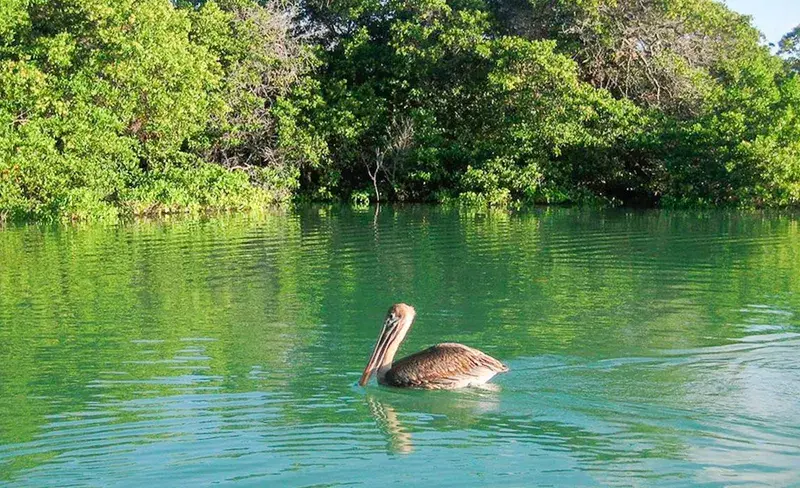
We enter this tranquil lagoon surrounded by mangroves by dingy, paddling to remain as quiet as possible. From December to March, the Pacific green turtles come here to breed. Young white-tipped reef sharks, schools of spotted eagle rays and golden rays are often spotted. Three species of mangrove; red, white and black, are all found here.
We enter this tranquil lagoon surrounded by mangroves by dingy, paddling to remain as quiet as possible. From December to March, the Pacific green turtles come here to breed. Young white-tipped reef sharks, schools of spotted eagle rays and golden rays are often spotted. Three species of mangrove; red, white and black, are all found here.
The sand at Las Bachas is made of decomposed coral, which makes it white and soft, and a favorite site for nesting sea turtles.
The Sally Lightfoot crabs are abundant on the lava rocks along the water's edge. These crabs will eat anything they can get their claws on.
On this hike, we saw flamingos, sally light-foot crabs, hermit crabs, black-necked stilts, and whimbrels.
A very small island packed to its steep-cliffed shoreline with fascinating life. Sea lions, land iguanas and tropical birds like swallow-tailed gulls and red-billed tropicbirds can be seen against a background of vegetation that changes color with the seasons.
It is possible to snorkel.
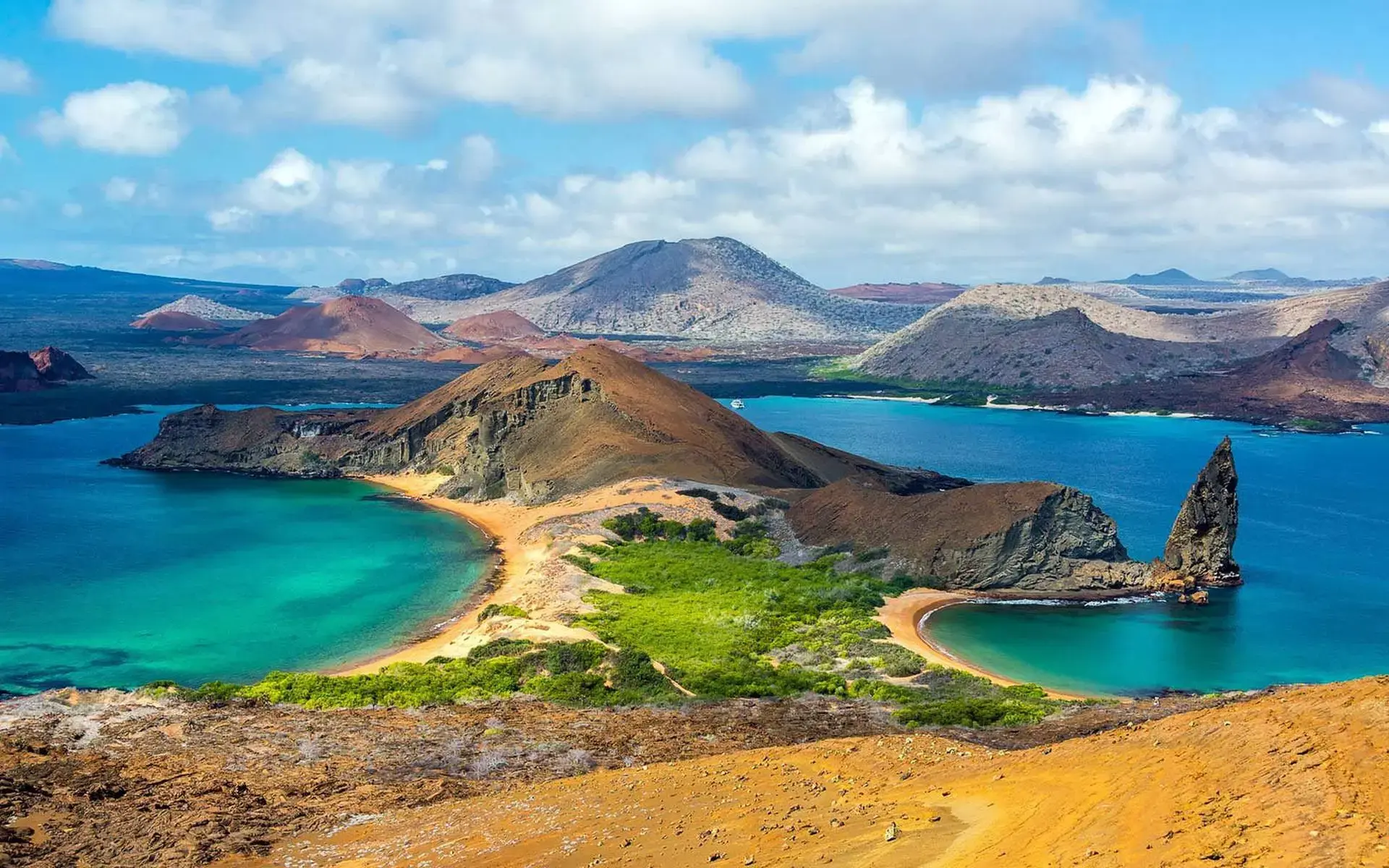
It is a tiny island of just 1,2 sqkm2 and offers one of the most photographed sites in Galapagos - Pinnacle Rock, an eroded tuff cone. A 30 minutes climb to the summit of a once active volcano offers a panoramic view of Sullivan Bay. The view is educational as well as inspiring, featuring lava formations – spatter cones and lava tubes.
On this island there is an excellent opportunity to snorkel from the beach that lines the northern shore. Frequently, penguins are spotted in this area. Take a walk through mangroves to the southern beach. Here, you may find mating sea turtles and white tipped sharks close to shore.
Some of the species that we can find here are the Galapagos penguin, lava lizard, Galapagos grasshopper, sea turtle, Galapagos shark. Plants like tiquilia, chamaesyle plants, scalesia stewartii, brachycereus cactus, red mangrove, scutia pauiflora, maytenus octogana.
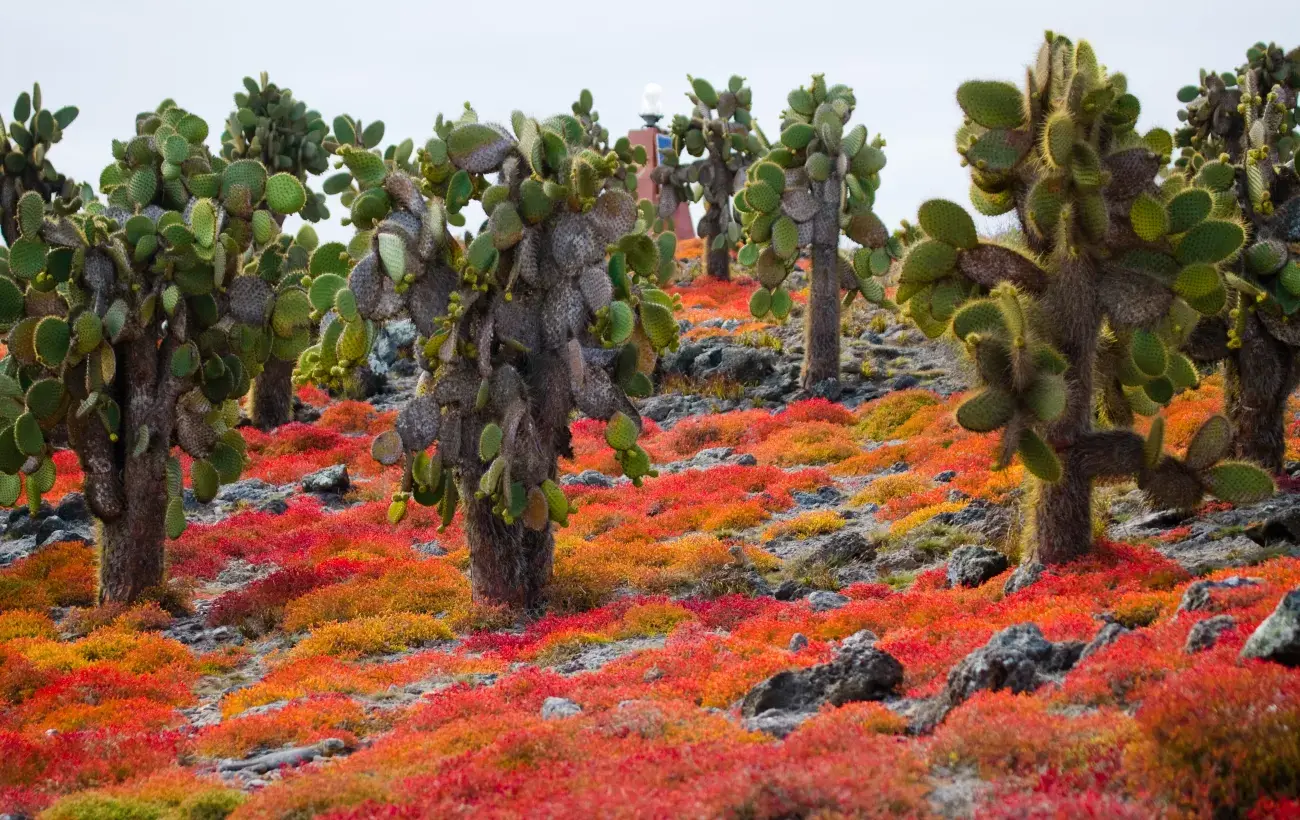
This 24 sqkm2 island is the result of an uplifting that raised the sea floor 259 meters above sea level. The vegetation of the island is characterized by the presence of the largest species of the giant opuntia cactus.
Two animal species highlight this island: the Santa Fe land iguana and the Galapagos rice rat. Also you can see lava lizards and sea lions. Here there is a swimming beach and it is possible to snorkel.
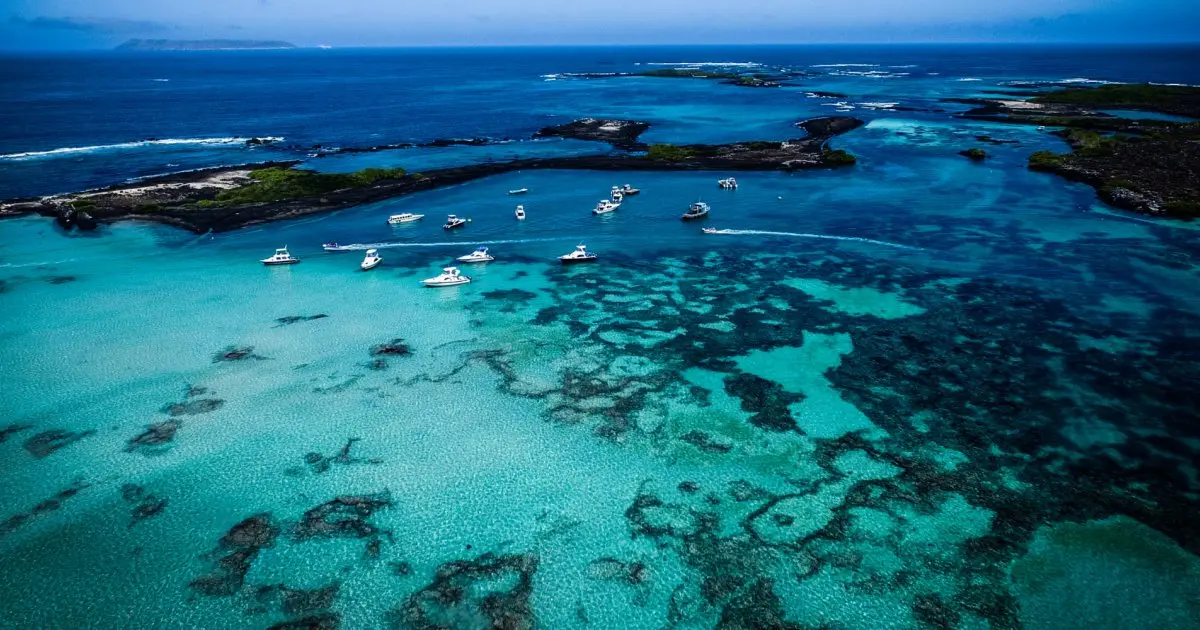
The southwestern half of this 558 km2 island is inhabited and was formed by an extinct volcano. This part of the island is characterized by lush vegetation and abundant water (including fresh water lakes). The highest point reaches 730 meters. The other half of the island, the northeastern part offers a dramatic contrast, with flat, dry and harsh environments.
The capital of the Galapagos Province is located on this island. This is the oldest settlement in Galapagos. In 1985, an airstrip was built here for flights to the mainland. An Ecuadorian naval base, souvenir shops and a newly emerging artistic and surfing community make up this small bayside village.
There is an Interpretation Center funded by the government of Spain in the town which opened in August 1998. Learn about the human history of the islands through elaborate displays and audio presentations.
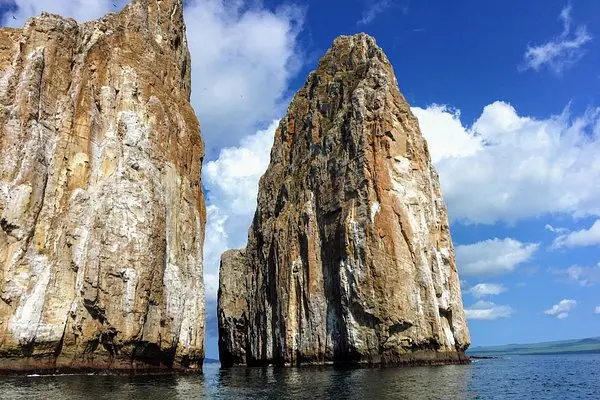
This is a vertical tuff cone that abruptly juts up almost 500 feet out of the ocean. Erosion has split the rock and given it its characteristic shape. The vessels cruise around the sheer cliffs. Look for blue-footed boobies, frigate birds and sea lions that line the shore.
This is a long, beautiful, white, powdery-sand beach which offers a short trail leading to sea lions, pelicans and blue- footed boobies.
Visit the highlands of San Cristobal by bus to reach the only sizeable fresh water lake in Galapagos where we find stilts, white-cheeked pintail ducks and common gallinules. Pass through several vegetation zones and El Progreso, a farming community.
A short distance from port, Lobos Islet is a seasonal nesting location for the blue-footed booby, although it is named after the sea lions found here. There is a short walk over rugged terrain.
This is a small beach that offers a subtle introduction to the Galapagos. There is a short trail leading to a sandy beach good for swimming. Pelicans and other Galapagos seabirds fly overhead.
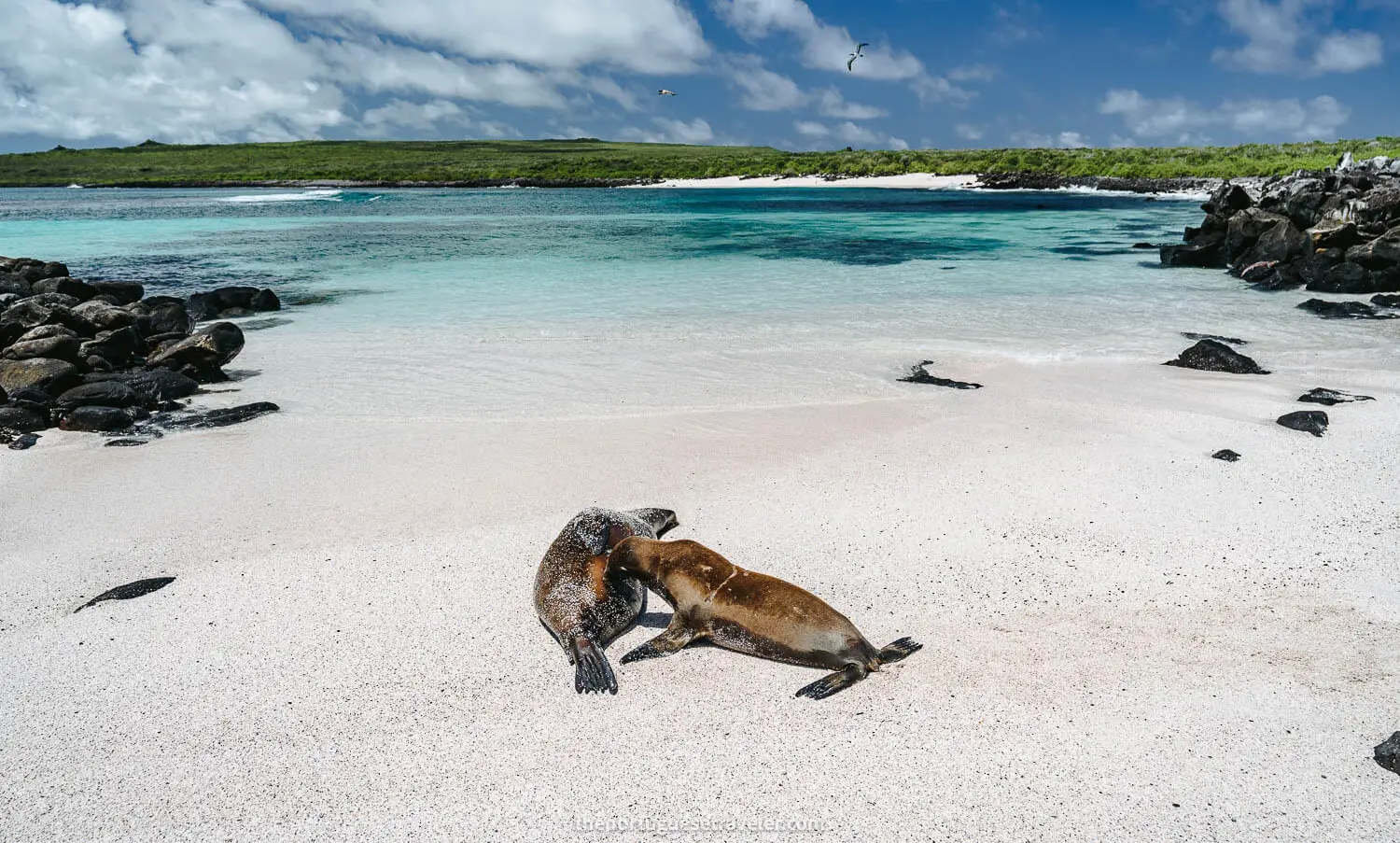
A relatively flat island, its rocks are among the oldest in the Archipelago. Some geologists describe this 60 Km2 island as the remains of an eroded archaic volcano. The vegetation corresponds to arid and transition zones. This rocky point of land sustains one of the most impressive and varied colonies of sea birds in Galapagos. Along its southern shore, steep cliffs rise up from the sea, for a spectacular view of soaring birds and the famous blowhole. A noisy colony of sea lions and curious mockingbirds greet us as we land on their beach. In season, we find waved albatross performing their unique mating ritual. You will meet a multitude of blue-footed boobies and masked boobies protecting eggs and young chicks. Endemic marine iguanas with unique traces of red and green soak up the heat from the sun.
ocated on the northeastern portion of Española, this is a good spot for swimming. On shore, we walk along the brilliant white, powdery-sand beach. This site is favored by sea turtles for nesting and sea lions for peaceful walks. Snorkeling is best done from the panga at Tortuga or Gardner Islet.
Some of the animals found here are the waved albatross, (there is a colony present April to November), blue-footed booby, masked booby, marine iguana, hood mockingbird, lava lizard, Galapagos dove, swallow-tailed gull, red-billed tropic bird, sea lion colonies, large cactus finch, sally lightfoot crab and Galapagos hawk.
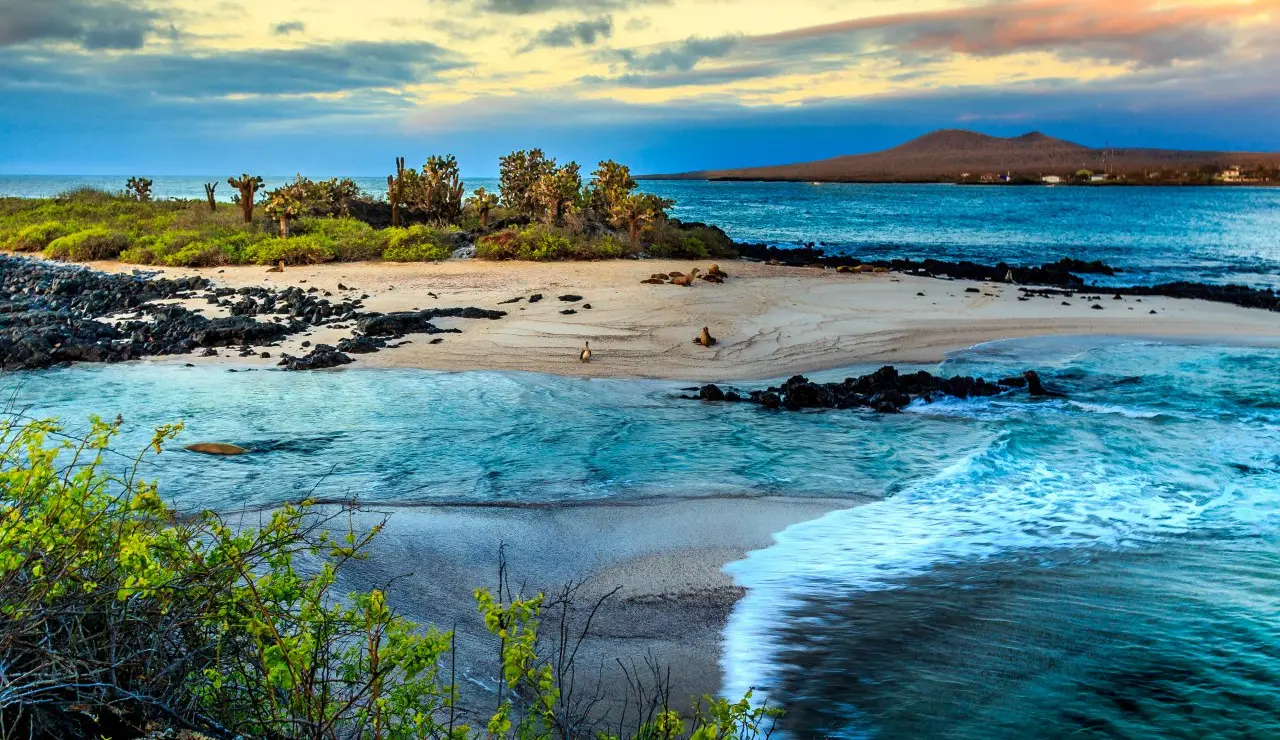
An island with a gentle landscape dominated by parasitic cones. If a central volcano ever existed it has eroded, long ago. This island, 640 m high, was the first inhabited island of the Archipelago and is endowed with a bizarre collection of stories. Floreana beholds beautiful visitor’s sites.
We land on a beach with olive-colored sand due to the volcanic crystals of magnesium and iron. The trail leads to a brackish lagoon where there are flamingos (the pinkest in the world) surrounded by palo santo trees. Pass through a rich variety of plant life to reach a soft coral sand beach where sea turtles lay their eggs in the sand dunes. Stingrays and black-tipped sharks swim along the shallow water.
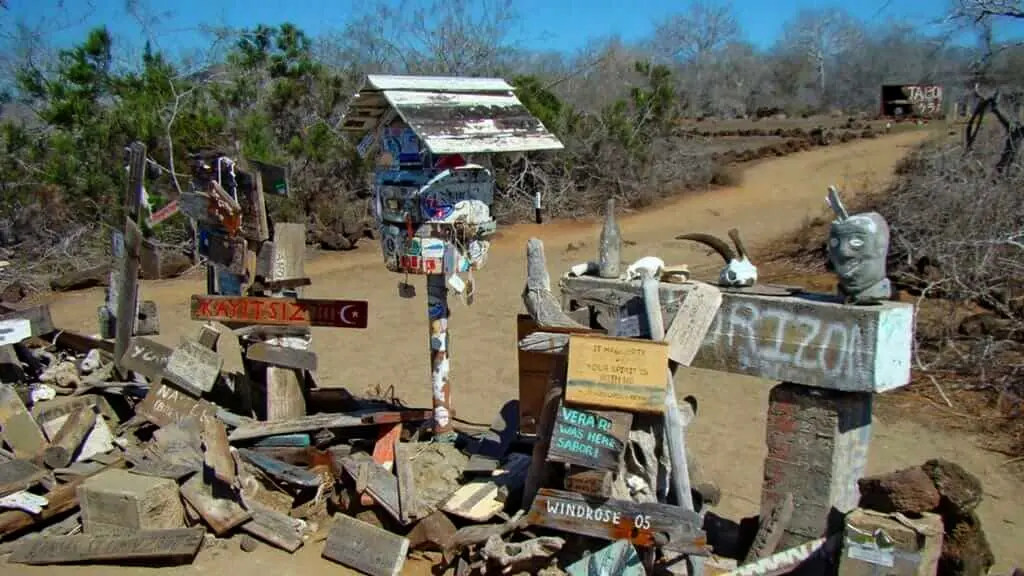
Here in the 18th century, the whalers opened an unofficial post office in the form of a barrel. This barrel has been in service ever since and the cost of postage has not gone up a single penny.
This shallow sunken crater makes for one of the best snorkeling sites in Galapagos. The almost completely submerged volcano offers snorkelers the chance to play in the water with sea lions. See a wide variety of colorful fish in the clear blue water. One must be a good swimmer as currents can be very strong.
The plants found here are morning glory, cutleaf daisy, lentana peduncularis, sesuvium portulacastrum, palo santo, scalesia villosa, nolana galapagensis, poligalasacti-georgii. We can also see greater flamingo, pintail duck, common stilt, brown pelican, common gallinule, audubon shearwater, medium tree finch, yellow warbler.

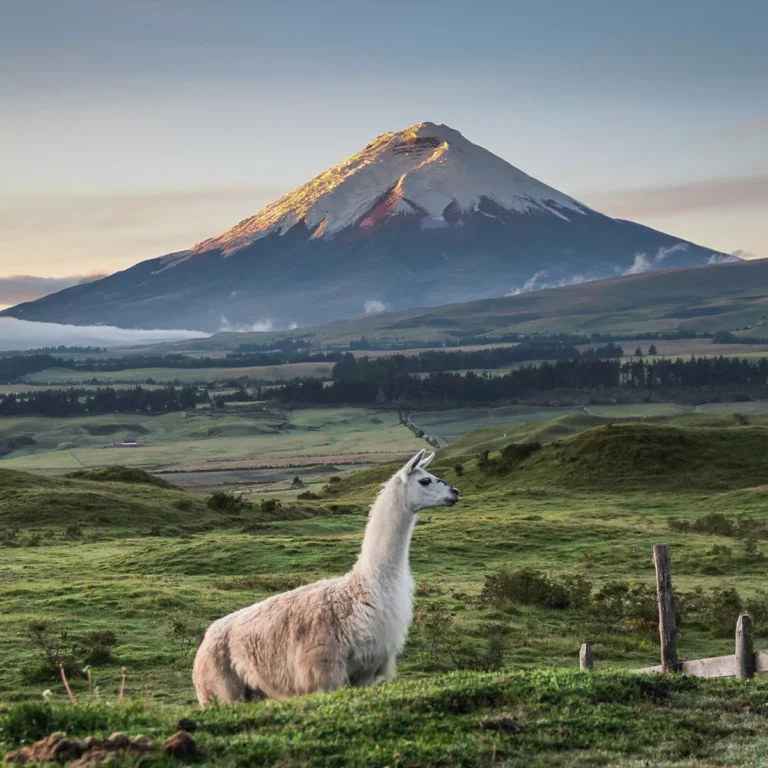
Ecuador travel offers an incredibly diverse and compact experience. From the unique, wildlife-rich Galapagos Islands and the majestic peaks of the Andes Highlands with their vibrant indigenous cultures, to the lush, biodiverse Amazon rainforest and the laid-back Pacific coast, Ecuador packs a world of natural wonders and cultural encounters into a relatively small area.
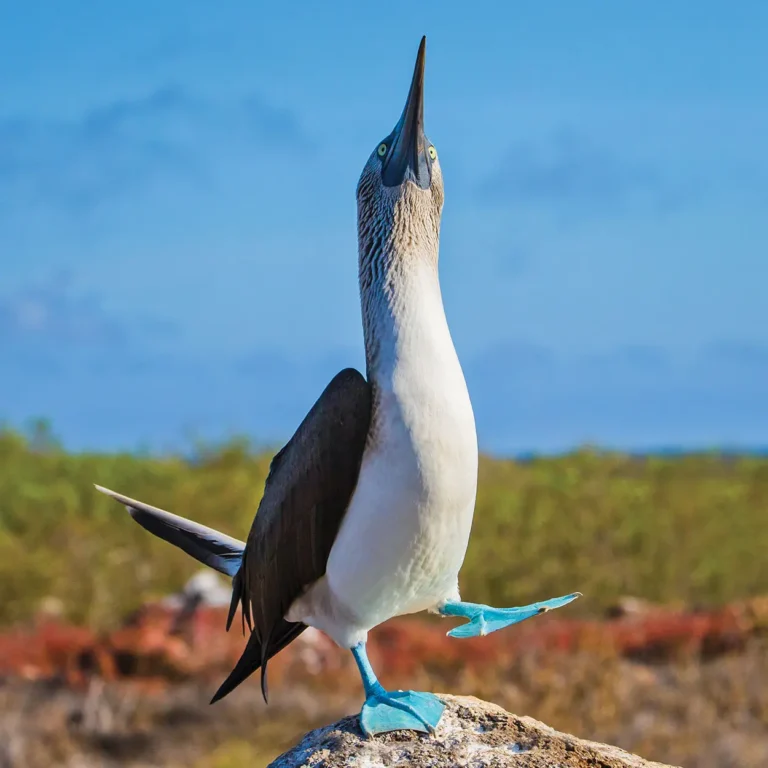
Galapagos tours provide an incredible opportunity to explore a unique volcanic archipelago teeming with fearless, endemic wildlife. Led by knowledgeable naturalists, these multi-day excursions offer close encounters with diverse species through guided walks, snorkeling, and boat navigation, revealing the islands' raw beauty and evolutionary marvels.
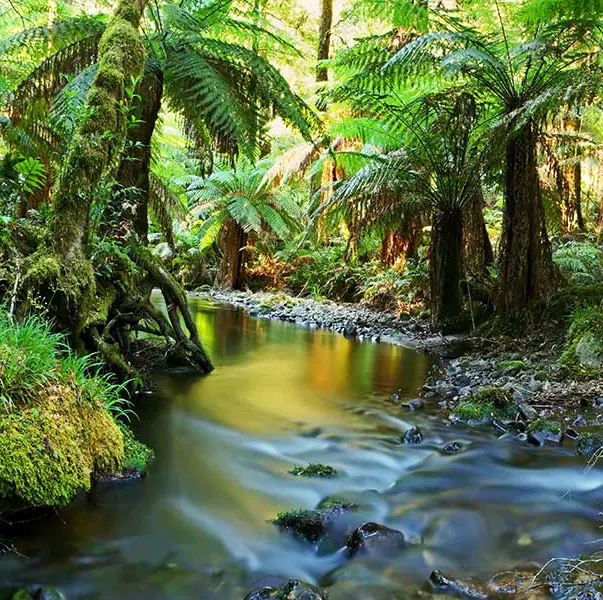
Ecuador rainforest expeditions offer deep dives into the heart of the Amazon, providing unparalleled immersion in one of the world's most biodiverse ecosystems. These journeys combine thrilling wildlife encounters—spotting monkeys, vibrant birds, and elusive predators—with cultural exchanges with indigenous communities, all while navigating lush landscapes and winding rivers.
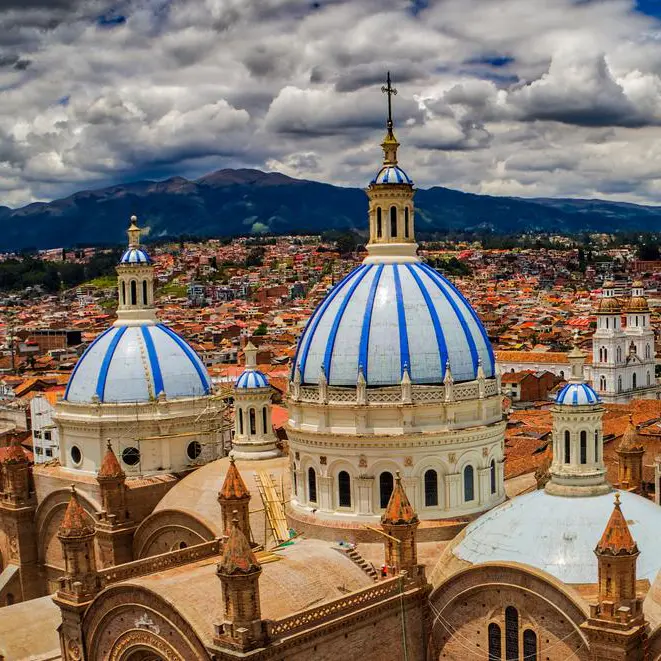
Explore the vibrant heart of Ecuador's Andes with activities like hiking majestic volcanoes (Cotopaxi, Chimborazo), exploring picturesque colonial cities (Quito, Cuenca), bargaining for unique crafts at bustling indigenous markets (Otavalo), and discovering hidden cloud forests. Enjoy horseback riding, mountain biking, or simply soaking in the breathtaking mountain vistas and rich cultural heritage.
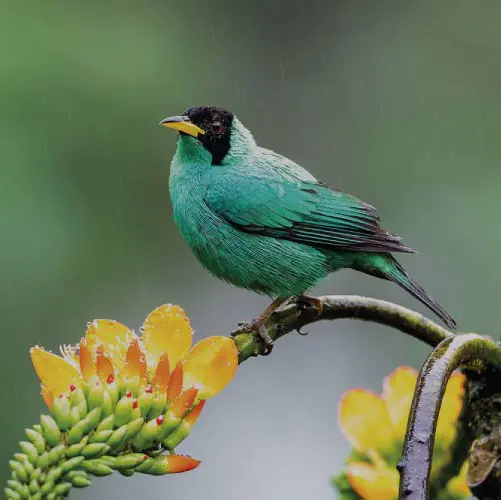
Ecuador is a birder's paradise, boasting an incredible diversity of species across its varied ecosystems. Birdwatching tours in Ecuador offer unparalleled opportunities to spot vibrant hummingbirds in the cloud forests, rare antpittas in the Andes, colorful macaws in the Amazon, and unique endemic species in the Galapagos.
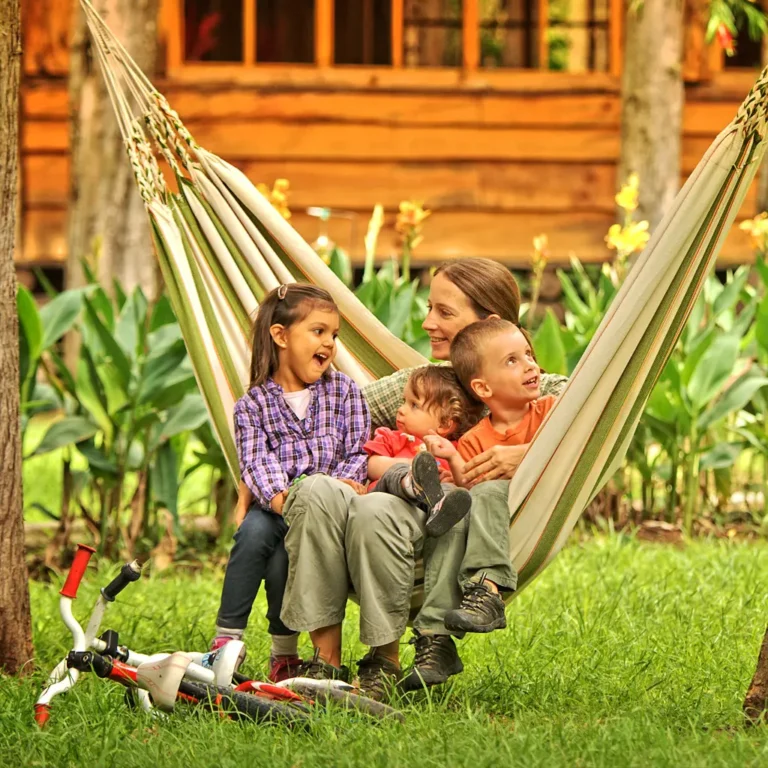
Family journeys in Ecuador offer diverse and engaging adventures for all ages. From wildlife encounters in the Galapagos and Amazon rainforest that spark wonder in children, to cultural explorations in the Andes highlands with their vibrant markets and charming towns, and relaxing moments on the Pacific coast, Ecuador provides a safe and stimulating environment for creating unforgettable family memories.
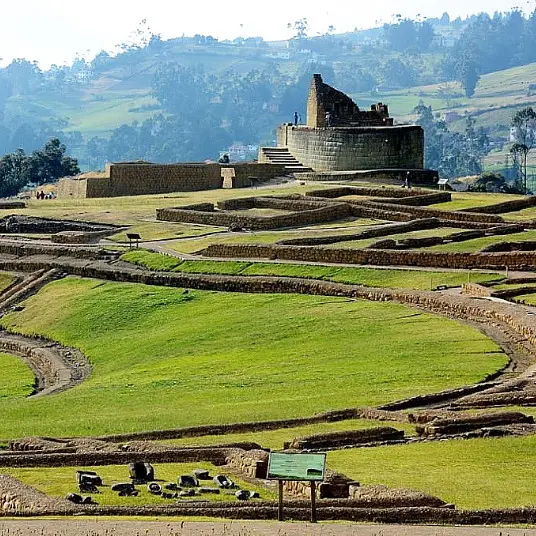
Ecuador's History & Archeology tours delve into a rich past, from ancient pre-Incan civilizations to the grandeur of the Inca Empire and the legacy of Spanish colonialism. Explore meticulously preserved colonial cities like Quito, a UNESCO World Heritage site, discover enigmatic archeological sites such as Ingapirca with its impressive Inca ruins, and learn about the diverse cultures that shaped this fascinating nation.
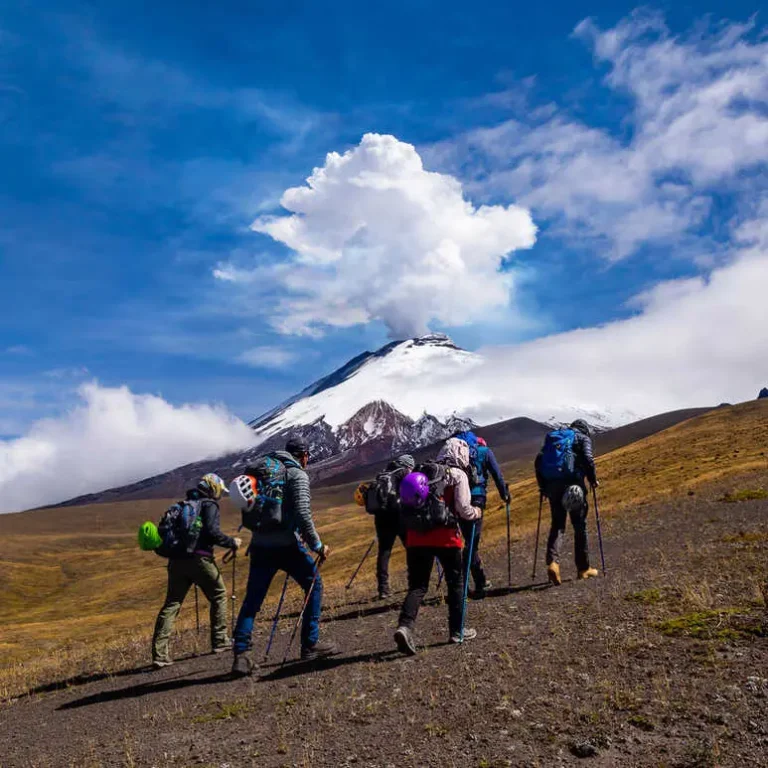
Ecuador hiking and trekking tours offer an extraordinary range of experiences amidst stunning Andean landscapes. From challenging ascents of majestic volcanoes like Cotopaxi and Chimborazo to scenic multi-day treks through cloud forests and paramo, and more gentle walks to explore indigenous villages.
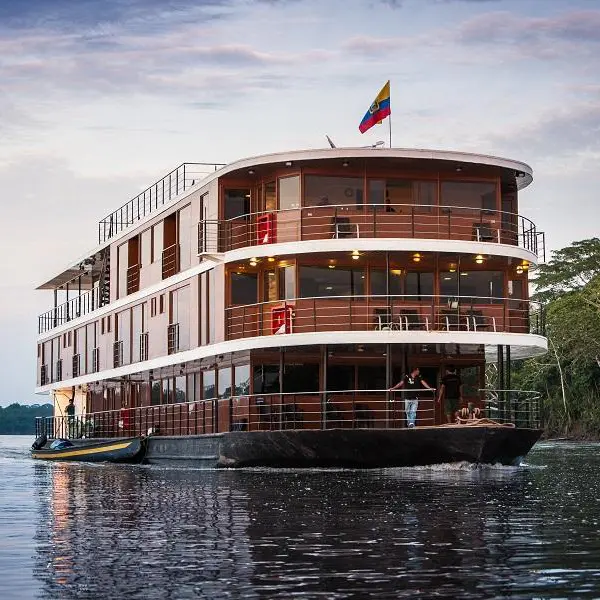
Ecuador boat cruises primarily focus on the Galapagos Islands, offering an unparalleled way to explore this unique archipelago. Options range from comfortable tourist-class vessels to luxurious yachts, providing accommodations, meals, and daily guided excursions. While less common, some river cruises also operate in the Amazon.
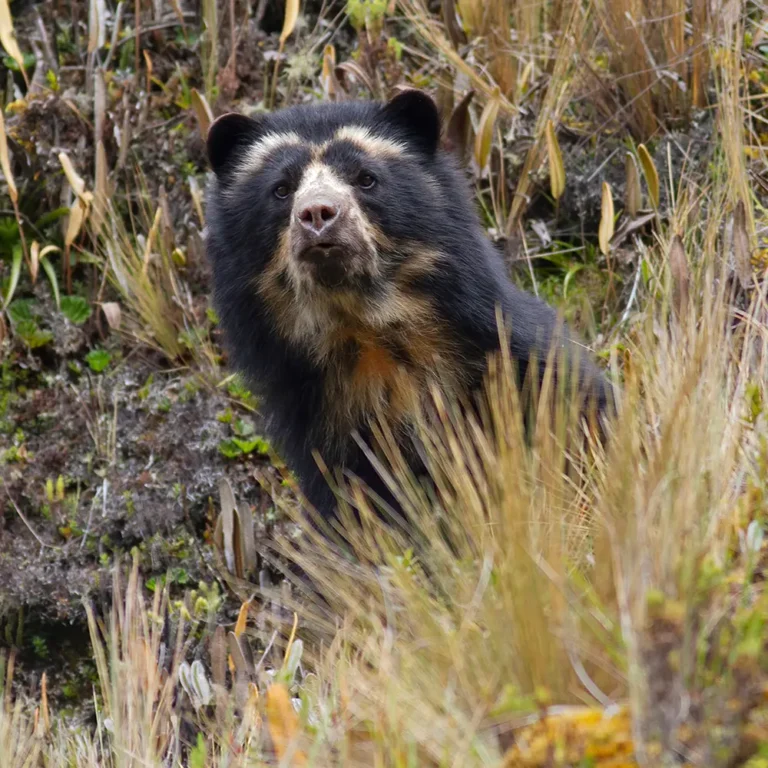
Ecuador's Nature and Wildlife tours are an absolute delight for nature lovers, offering unparalleled biodiversity in a compact country. Explore the unique, fearless wildlife of the Galapagos Islands, discover a profusion of species in the Amazon rainforest (monkeys, macaws, anacondas), and encounter rare birds and fascinating mammals in the Andean cloud forests and paramo.
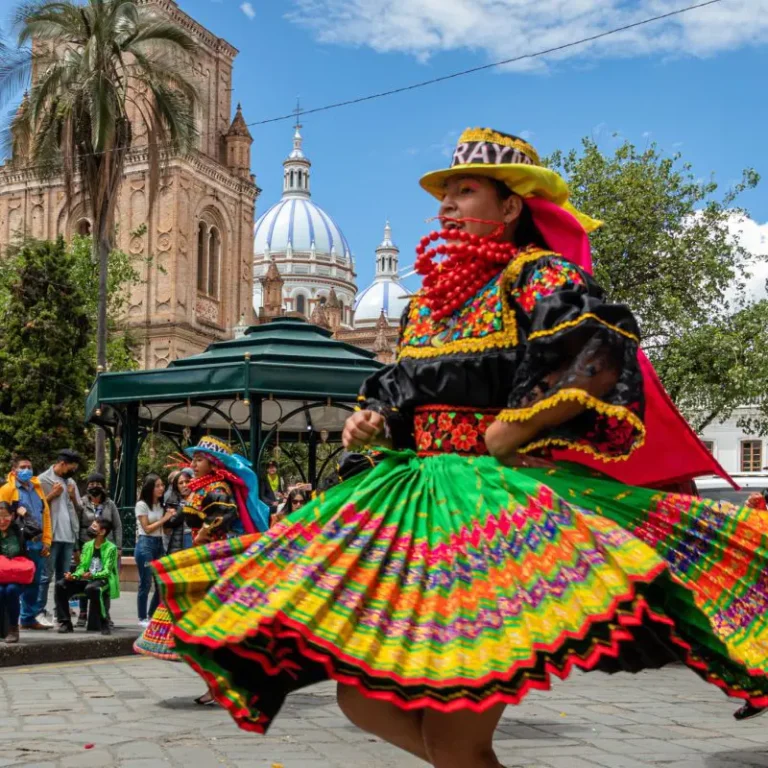
Ecuador People and Culture tours offer a vibrant immersion into the heart of this diverse nation. Explore bustling indigenous markets like Otavalo, where ancient traditions thrive through colorful textiles and handicrafts. Discover the architectural grandeur and living history of UNESCO World Heritage cities like Quito and Cuenca.
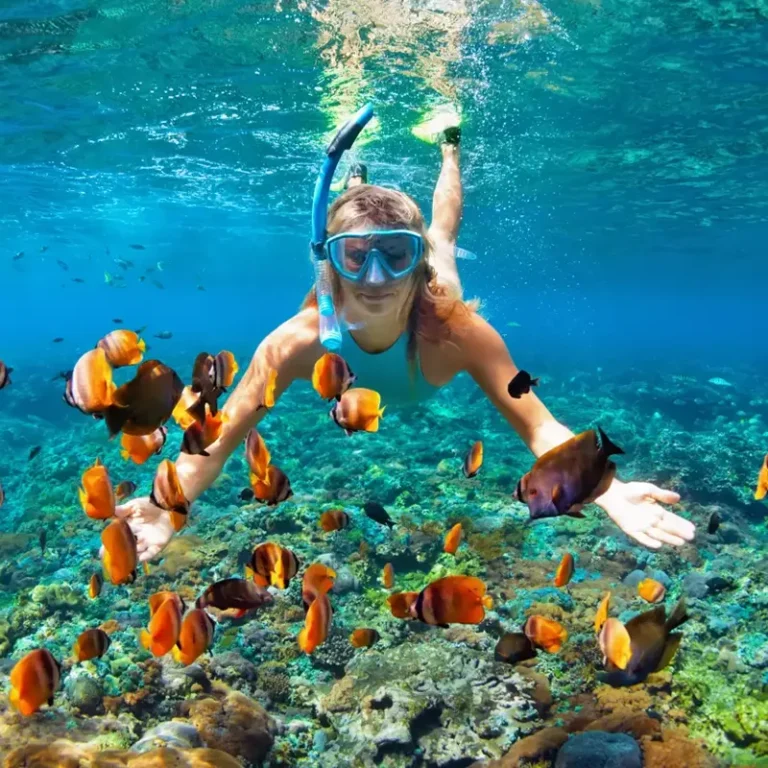
Ecuador's snorkeling and diving tours primarily focus on the Galapagos Islands, offering an unparalleled underwater adventure. Dive into crystal-clear waters teeming with unique marine life found nowhere else: playful sea lions, graceful sea turtles, hammerhead sharks, whale sharks, marine iguanas, and countless colorful fish.
